
Portable Power Station vs Dual Battery System: Which Suits Your Camping?
Affiliate disclosure: OutbackKit may earn a small commission if you buy through links on this page, at no extra cost to you. We only recommend gear we’d be happy to take on our own trips.
Once you’ve got a 12V fridge, the next question is always the same: how do I keep it running? In Australia, the two main options are a dual battery system fitted to your vehicle, or a portable power station, the all-in-one battery boxes that have become very popular over the past few years.
Both work. Which one is right depends on how you camp, what vehicle you drive and how much you want to spend on installation. Here’s an honest comparison.
What each one actually is
Dual battery system
A second battery, usually deep-cycle AGM or lithium, is mounted in the engine bay, tray, canopy or a drawer system. It’s charged while you drive through a DC-DC charger (or, in older setups, an isolator) and kept separate from your starting battery, so the fridge can’t flatten the battery you need to start the car. It’s typically installed by an auto electrician, though experienced DIYers do their own.
Portable power station
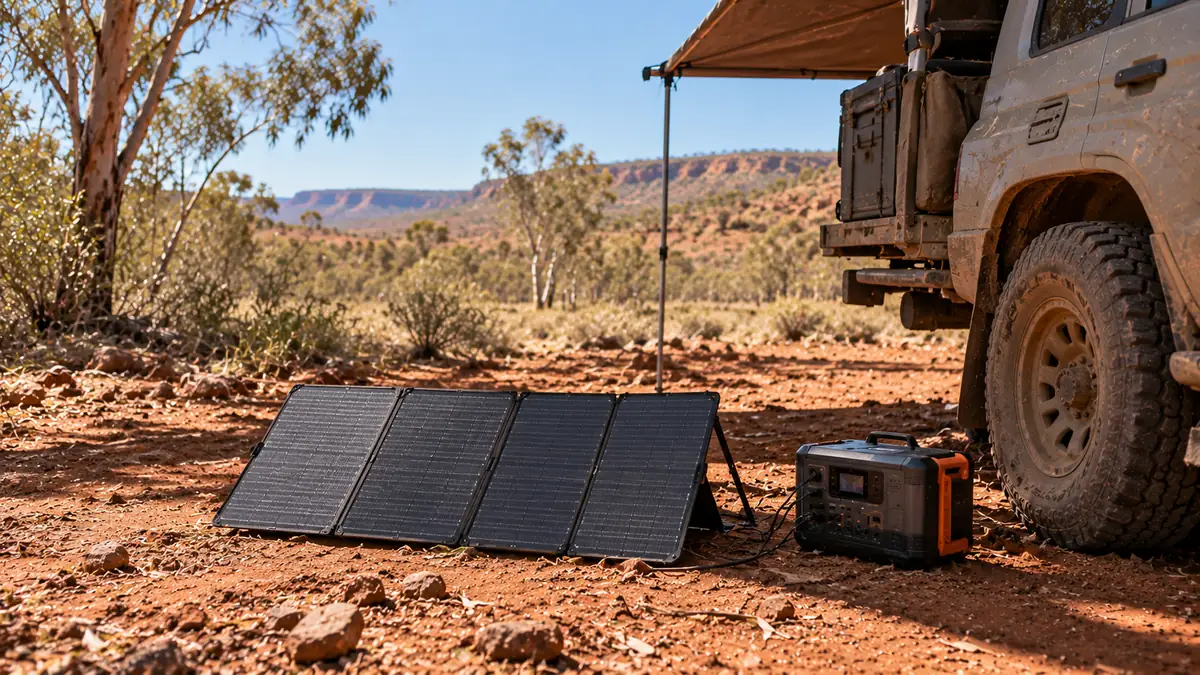
This is a self-contained unit with a lithium battery, an inverter (for 240V devices), 12V outlets, USB ports and a built-in charge controller, all in one box with a handle. You can charge it from a wall socket, your car’s 12V socket, solar panels or, on some models, a dedicated DC-DC input. You carry it wherever you need it.
The quick comparison
| Factor | Dual battery system | Portable power station |
|---|---|---|
| Upfront cost | Battery + DC-DC charger + wiring + installation. | Unit only, plus optional solar. |
| Installation | Professional or skilled DIY | None, plug and go |
| Portability | Fixed in the vehicle | Carry it into the tent, the house or another car |
| Charging while driving | Usually fast and efficient with a proper DC-DC charger | Often limited by a 12V socket’s output unless you add a dedicated input |
| 240V appliances | Needs an extra inverter | Built in on most models |
| Space and weight | Mounted out of the way | Takes up cargo space |
| Multiple vehicles | Tied to one car | Moves between vehicles easily |
| Resale | Stays with the car | You keep it |
When a dual battery system makes more sense
- You do long trips or remote touring. Charging while driving is the big advantage. A well-installed system with a properly sized DC-DC charger tops your battery up efficiently every time you drive, so multi-week trips are much easier.
- You’ve got one dedicated touring vehicle. If your 4WD is set up for touring and stays that way, a fixed system is tidy and secure, and it frees up cargo space.
- You want a clean, permanent setup. Hard-wired Anderson points in the canopy, lighting and a fridge outlet always ready to go.
- You run several 12V loads at once, such as a fridge, a second fridge or freezer, lights, a water pump and a compressor.
Things to watch:
- Installation quality matters a lot. Undersized cable, poor earths and bad fusing cause most of the dual-battery problems we hear about. Use a licensed auto electrician if you’re unsure.
- Newer vehicles with smart alternators generally need a DC-DC charger, not a simple isolator, to charge the second battery properly. Ask your installer.
- Check your vehicle’s warranty and any insurance implications before modifying the electrical system.
- Engine-bay heat shortens battery life, especially for some chemistries. Many lithium setups are installed in the cabin or tray instead. Check the manufacturer’s guidance.
When a portable power station makes more sense
- You camp in more than one vehicle, or in a car you don’t want to modify (a leased car, company car or the family wagon).
- You mostly do weekenders or caravan-park stays where you might also have 240V power or will be driving home soon.
- You need 240V on the go for things like a laptop, CPAP machine, camera batteries or a small appliance (check the wattage).
- You want it to double as home backup during a blackout.
- You don’t want installation work or holes drilled in your car.
Things to watch:
- Charging from a car’s 12V socket is often slow. Many cigarette-lighter sockets can only deliver modest power, and some turn off with the ignition. Check how fast the unit can charge from 12V, and look at a dedicated DC-DC charging option if you’ll rely on driving to recharge.
- Capacity claims need care. Watt-hours (Wh) is the number to compare. Inverter losses mean you won’t get the full figure out when running 240V devices.
- Battery chemistry. Many current units use LiFePO4 (lithium iron phosphate), which is generally rated for more charge cycles than other lithium types. Check the cycle rating and the warranty.
- It’s still cargo. Larger units are heavy and need to be tied down properly in the vehicle.
- Heat. Don’t leave it baking on the dash or in direct sun.
Working out how much capacity you need
Whichever way you go, do the maths before buying. A simple method:
- List your loads. Fridge, lights, phone charging, a fan, a CPAP and so on.
- Estimate daily use for each in watt-hours (Wh) or amp-hours (Ah at 12V). For a fridge, use the manufacturer’s realistic daily figure at hot temperatures, not the best-case number. (Roughly, Wh ≈ Ah × 12 for 12V systems.)
- Add them up for a daily total.
- Multiply by the number of days you want to go without recharging.
- Compare this with the usable capacity. Lithium is usually designed for deeper discharge than AGM or lead-acid, which generally shouldn’t be run as flat. Check the manufacturer’s recommended depth of discharge.
- Add a buffer for cloudy days, hot weather and battery ageing.
If the number is big, add solar rather than just buying a bigger battery. A folding solar blanket or panel lets you park in the shade and leave the panel in the sun.
Solar: works with both
- Dual battery: many DC-DC chargers include a solar input (MPPT), so a panel can feed the auxiliary battery directly.
- Power station: most have a built-in solar input. Check the maximum input voltage and wattage, and the plug type, so your panel is compatible.
Fixed roof panels suit people who are always on the move. Portable blankets suit people who park in shade or set up base camps.
The hybrid approach
Plenty of Aussie campers end up with both: a dual battery in the 4WD for the fridge while driving, and a small power station for the tent or for charging gear at camp. If budget allows, it’s a flexible setup. If it doesn’t, start with whichever suits your most common trip, and add the other later.
A simple way to decide
Ask yourself these four questions:
- Do I mostly camp out of one vehicle, on long or remote trips? → Lean dual battery.
- Do I swap cars, rent, lease, or not want to modify my car? → Lean power station.
- Do I need 240V at camp? → Power station, or dual battery plus an inverter.
- Will I recharge mostly by driving or mostly by solar or mains? → Driving favours dual battery. Solar or mains suits either.
Safety notes
- Use the right fuses and cable sizes for your current draw and cable length. Undersized cable is a fire risk and causes voltage drop.
- Secure everything. A loose battery or power station becomes a projectile in a crash or on rough tracks.
- Follow manufacturer instructions on charging temperatures. Lithium batteries often shouldn’t be charged below a certain temperature.
- If in doubt, get a licensed auto electrician to install or inspect it.
The bottom line
- Weekenders, multiple vehicles, renters and people who need 240V: a portable power station is the simplest choice.
- Dedicated touring 4WDs and long remote trips: a properly installed dual battery system with a DC-DC charger is hard to beat.
- Big trips and big budgets: use both.
Whichever you choose, size it with real numbers, not best-case brochure figures, and pair it with solar if you’ll be stationary for more than a day or two.
Compare current options at the major Australian camping and 4WD retailers.
Prices and specifications change often. Always confirm the current details with the retailer before buying, and follow the manufacturer’s installation and safety instructions.