
12V, Dual Battery and Solar Basics for Camping
Disclosure: As an Amazon Associate, OutbackKit earns from qualifying purchases. Some links on this page are affiliate links, so we may earn a small commission if you buy through them, at no extra cost to you. We only point to gear we’d be happy to take on our own trips.
Camp power can seem like a maze of acronyms. But the basic idea is simple: store energy in a battery, use it to run your fridge, lights and chargers, and top it back up from your vehicle or the sun. This guide explains the pieces and how they fit together.
Safety first: vehicle electrical work involves high currents that can cause fires. Unless you know what you’re doing, have a qualified auto electrician install fixed wiring.
The key terms
- Volts (V): electrical “pressure”. Most camping gear runs on 12V.
- Amps (A): the current a device draws.
- Amp-hours (Ah): battery capacity, meaning how many amps it can supply for how many hours.
- Watts (W): power. Watts = volts × amps.
- Watt-hours (Wh): energy. Power stations are often rated in Wh, batteries in Ah. Multiply Ah by the battery’s voltage to convert.
Why not just use the starter battery?
Your vehicle’s starting battery is designed to deliver a big burst of power to crank the engine, not to be drained slowly overnight. Flatten it running a fridge and you might not start the car in the morning, which is a serious problem somewhere remote. That’s why campers add a second, auxiliary battery.
What a dual battery system is
A dual battery system adds a second (deep-cycle) battery that runs your camping gear, while the starter battery is kept isolated for starting the engine. The main parts are:
- Auxiliary battery. Usually AGM or lithium (LiFePO4). Lithium is lighter and tolerates deeper discharge, but costs more. AGM is heavier but cheaper and well proven. (Renogy 12V 100Ah LiFePO4 battery (Bluetooth BMS) on Amazon)
- DC-DC charger. Charges the auxiliary battery from the alternator while you drive. Modern vehicles with “smart” alternators generally need one to charge an auxiliary battery properly. Many also include a solar input. (DC-DC chargers on Amazon)
- Wiring, fuses and circuit breakers sized for the current involved.
- Outlets, such as Anderson plugs, 12V sockets and USB points.
- A battery monitor, which shows how much charge you really have.
Alternatively: a portable power station
A power station is an all-in-one box with a battery, inverter and outlets. It’s portable, needs no installation and can be charged at home, from your car or from solar. It’s a great option for renters, people with several vehicles, or anyone who wants simplicity. We compare the two in power station vs dual battery.
How solar fits in
When you’re camped for several days, you’re not driving, so the alternator isn’t charging anything. Solar fills that gap.
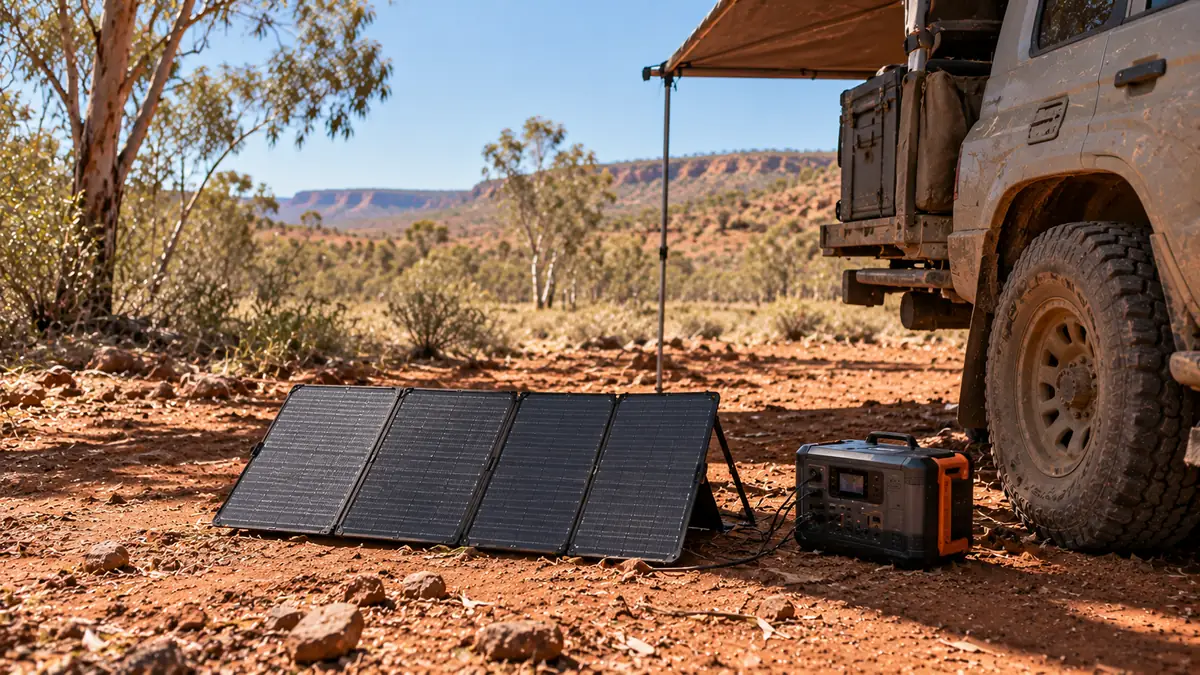
- Portable folding panels or blankets can be placed in the sun while your vehicle sits in the shade. (folding solar panels on Amazon)
- Fixed roof panels charge whenever the vehicle is in the sun, including while you drive, but your car has to be parked in sunlight.
- A solar regulator (controller) is essential. It protects the battery from overcharging. Some panels have one built in, and many DC-DC chargers include one. Look for MPPT for better efficiency.
Real-world solar output is usually well below the panel’s rated wattage, because of sun angle, heat, cloud and shading. Plan with a healthy margin.
Sizing a basic system: a simple method
- List your devices and their power draw (check the label or manual).
- Estimate the hours per day each one runs. Fridges cycle on and off, so their average draw is lower than the label figure, and it rises in hot weather.
- Multiply and add up to get your daily use in amp-hours or watt-hours.
- Choose usable battery capacity to cover that for the number of days you might go without charging. Remember that AGM batteries shouldn’t be regularly drained as deeply as lithium.
- Choose charging (alternator plus solar) that can replace your daily use in a typical day.
If the maths feels uncertain, use the manufacturer’s figures and round up. Running out of power and having your fridge fail is worse than a little spare capacity.
Common mistakes
- Undersized cable from the front to the rear of the vehicle, which causes voltage drop and slow charging.
- No fuses or the wrong fuse rating. This is a genuine fire risk.
- Mixing battery types or old and new batteries.
- Parking the panel in shade or leaving it flat on the ground at midday in winter.
- Not monitoring the battery and discovering it’s flat at dinner time.
Top of the line vs best value
Well-known options sold in Australia, if you want a starting point. We haven’t independently tested every one, prices change often, and the right choice depends on your trip, so check current prices, specs and warranty before buying. Not ready to buy? Pop it in your Amazon cart so it’s there when you are.
Portable power station
- Top of the line: EcoFlow DELTA 2 Max on Amazon · Add to Amazon cart: premium high-capacity unit with fast charging.
- Best value: Anker SOLIX C300 on Amazon · Add to Amazon cart: smaller, budget-friendly unit for phones, lights and fans.
Further reading
The bottom line
For short trips, a portable power station plus a folding solar panel is the easiest way to start. For regular touring, a professionally installed dual battery system with a DC-DC charger and solar input is a robust long-term setup. Either way, know your daily usage, and size charging as carefully as storage.
Always follow manufacturers’ instructions and Australian electrical safety requirements.