4WD Tyre Pressures and Tyre Care for Off-Road Trips
Disclosure: As an Amazon Associate, OutbackKit earns from qualifying purchases. Some links on this page are affiliate links, so we may earn a small commission if you buy through them, at no extra cost to you. We only point to gear we’d be happy to take on our own trips.
Tyres are the only part of your vehicle touching the ground, and on an off-road trip they take a beating. Getting tyre pressures right and looking after your tyres improves traction, comfort and safety, and reduces the chance of damage far from help.
This guide covers general principles only. Always follow your vehicle manufacturer’s and tyre manufacturer’s recommendations, and adjust for your load, speed and conditions. A 4WD training course is a great way to learn hands-on.
Why adjust tyre pressure off-road?
Lowering tyre pressure lets the tyre flex and lengthens its footprint on the ground. That:
- Improves traction on sand, mud, rocks and loose surfaces
- Smooths the ride on corrugations
- Reduces the risk of some types of damage, as a softer tyre can mould around sharp rocks rather than being punctured
- Reduces damage to tracks, because spinning wheels dig less
The trade-offs:
- Too low risks rolling a tyre off its rim, damage to sidewalls and overheating, especially at higher speeds or with heavy loads.
- Lower pressures require lower speeds. The faster you go, the more heat the tyre builds up.
- Handling changes. Steering and braking feel different on lowered tyres.
General principles
- Start from the vehicle’s placard pressures (usually on the driver’s door pillar or in the owner’s manual) for normal road driving at your load.
- Lower pressures in steps to suit the surface, and only as much as you need. Sand typically needs more reduction than gravel, for example.
- Drive slower on lowered tyres, and avoid sharp turns and harsh braking.
- Adjust for load. A heavily loaded vehicle generally needs more pressure than an empty one.
- Check pressures when tyres are cold for consistency. Pressures rise as tyres warm up.
- Re-inflate before returning to the bitumen or higher-speed gravel roads.
- Get local and manufacturer advice for your specific tyres and conditions.
Essential tyre gear
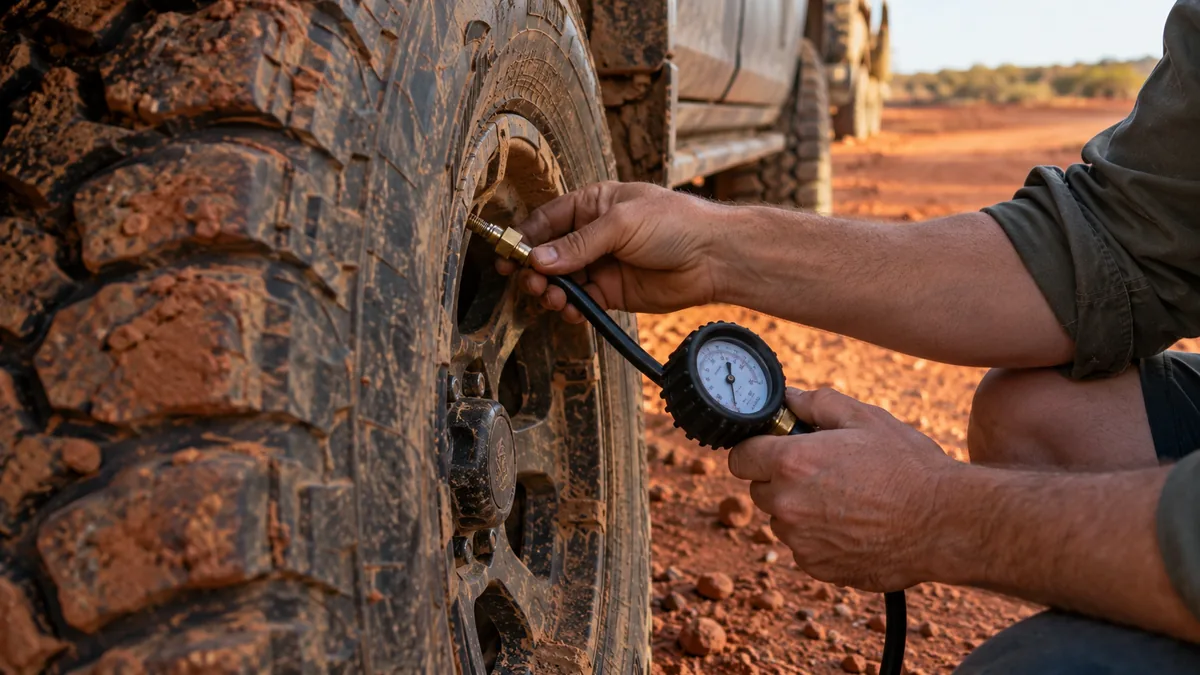
Pressure gauge
A quality, accurate gauge is essential. Cheap gauges can be inaccurate, and with lowered pressures a small error matters. (tyre pressure gauges on Amazon)
Tyre deflators
Deflators let air out quickly and evenly. Some types screw onto the valve and stop at a preset pressure. (tyre deflators on Amazon)
Air compressor
For re-inflating after the track. Look for:
- Enough airflow to inflate 4WD tyres in reasonable time
- A duty cycle suited to inflating four large tyres
- Wiring direct to the battery rather than a cigarette-lighter socket for higher-output units
- A long enough hose to reach all four tyres
- A reliable inline gauge
Tyre repair kit
A plug-style tyre repair kit can fix many tread punctures temporarily. (tyre repair kits on Amazon)
- Practise at home first.
- Plugs are generally a temporary repair. Have the tyre inspected by a tyre professional as soon as possible.
- Sidewall damage usually can’t be plugged safely. Fit the spare.
Spare tyre(s)
- Carry at least one full-size spare in good condition, matching your other tyres where possible.
- Consider a second spare for remote trips.
- Check the spare’s pressure before every trip.
- Make sure your jack, wheel brace and wheel nuts work with your vehicle, and practise changing a tyre at home.
- A jack base plate helps on soft ground.
Tyre care before and during trips
Before you go
- Check tread depth and condition. Look for cuts, bulges, cracks and uneven wear.
- Check tyre age. Tyres age even when they have plenty of tread.
- Rotate and balance according to your vehicle’s service schedule.
- Check wheel alignment if you notice uneven wear or pulling.
- Choose suitable tyres for the trip. All-terrain and mud-terrain tyres suit different conditions.
On the track
- Do a walk-around every morning and at each stop, looking for damage, low tyres and stones in the tread.
- Watch for sharp rocks, stakes and debris. Pick your line carefully.
- Feel tyres at stops. A tyre noticeably hotter than the others can signal a problem.
- Keep valve caps on to keep out dirt.
- A tyre pressure monitoring system (TPMS) can warn you of slow leaks. (tyre pressure monitors on Amazon)
Airing back up
- Re-inflate to suitable road pressures for your load before driving on bitumen or at higher speeds.
- Pull off somewhere safe, well off the road.
- Run the engine while using the compressor if your manufacturer recommends it, to avoid draining the battery.
- Let the compressor rest if it gets hot, according to its duty cycle.
- Re-check pressures once tyres have cooled, or at the next stop.
Common mistakes
- Lowering pressures but then driving too fast
- Forgetting to re-inflate before the highway
- Relying on an inaccurate gauge
- Not checking the spare
- Carrying a repair kit you’ve never practised with
See beach camping and sand driving and 4WD recovery gear essentials for more.
Tyre checklist
- Placard pressures known for your load
- Accurate pressure gauge
- Tyre deflators
- Air compressor, wired correctly
- Tyre repair kit, practised
- Full-size spare(s), checked
- Jack, base plate and wheel brace, tested
Top of the line vs best value
Well-known options sold in Australia, if you want a starting point. We haven’t independently tested every one, prices change often, and the right choice depends on your trip, so check current prices, specs and warranty before buying. Not ready to buy? Pop it in your Amazon cart so it’s there when you are.
Air compressor
- Top of the line: NOCO AIR20 12V compressor on Amazon · Add to Amazon cart: premium high-output portable 12V compressor.
- Best value: NOCO AIR10 12V compressor on Amazon · Add to Amazon cart: budget-friendly portable compressor for occasional use.
Tyre deflators
- Top of the line: Staun Automatic Tyre Deflators Heavy Duty on Amazon · Add to Amazon cart: premium automatic deflators.
- Best value: ATsafe 2-in-1 rapid tyre deflator on Amazon · Add to Amazon cart: budget-friendly manual deflator with a gauge.
Further reading
The bottom line
Follow your vehicle and tyre manufacturer’s guidance, lower pressures for the conditions, slow down on lowered tyres, carry a good gauge, deflators, compressor, repair kit and spare, and always re-inflate before the road. Look after your tyres, and they’ll look after you.