First-Time 4WD Camping Tips: What to Know Before You Go
Disclosure: As an Amazon Associate, OutbackKit earns from qualifying purchases. Some links on this page are affiliate links, so we may earn a small commission if you buy through them, at no extra cost to you. We only point to gear we’d be happy to take on our own trips.
Your first 4WD camping trip is a big step up from campground camping. The tracks are rougher, help is further away, and a small mistake can leave you stuck. The good news is that most problems are avoidable with a bit of planning. Here’s what to know before you go.
This guide is general information, not a substitute for training. A nationally recognised 4WD course or a local 4WD club is the best way to learn safely.
1. Start easy
- Pick a well-known, graded or easy track for your first trip, close to help and phone reception.
- Check track conditions and closures with the land manager. Many tracks close seasonally or after rain.
- Read your vehicle’s manual for low range, diff locks and any limits on wading depth.
- Do a 4WD course if you can. It covers recovery techniques that are hard to learn from reading.
2. Travel with another vehicle
Going with a second 4WD makes recoveries much safer and easier. If you travel alone, stick to easier tracks and carry a way to call for help. Our first aid and emergency comms guide covers PLBs, satellite messengers and UHF radios.
3. Get your tyre pressures right
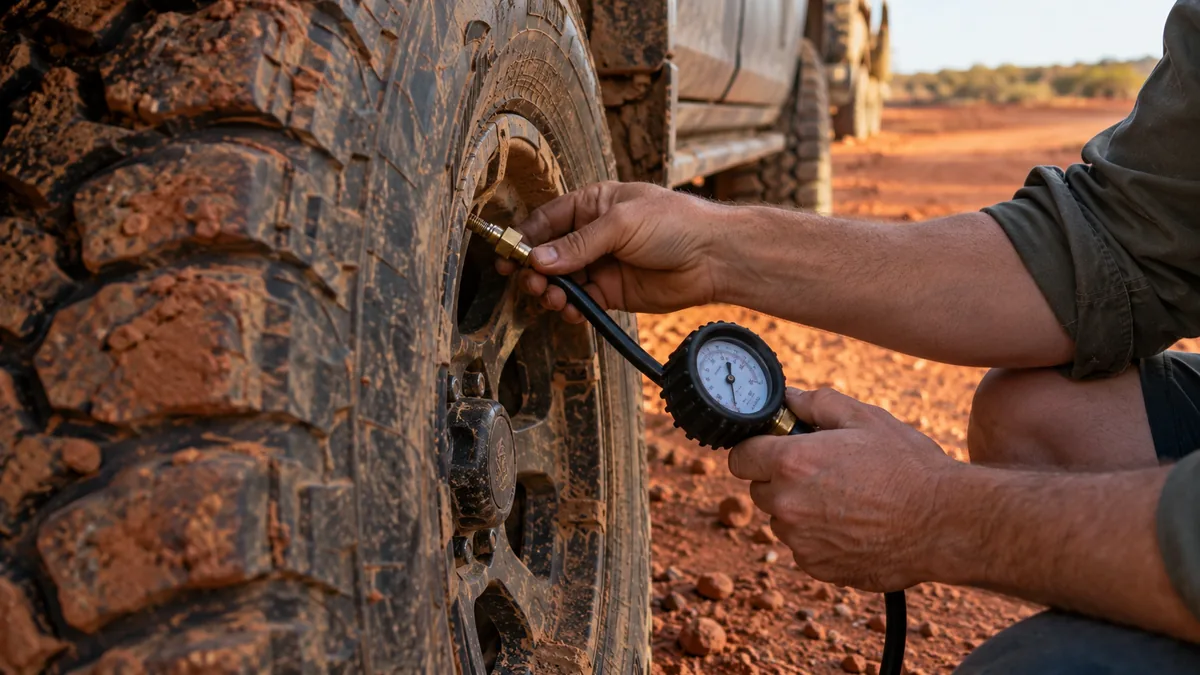
Lowering tyre pressures is one of the most important skills for sand, mud and rough tracks. It improves traction and ride, and reduces the chance of getting bogged. But you must reinflate before driving on bitumen or at higher speeds.
- Carry a gauge, deflators and a 12V compressor. (12V compressors on Amazon)
- Follow your vehicle and tyre maker’s guidance and drive slower at lower pressures.
- Read our full 4WD tyre pressures guide.
4. Carry basic recovery gear, and know how to use it
A beginner’s recovery kit usually includes:
- Recovery boards for sand and mud.
- A snatch strap with a minimum breaking strength 2 to 3 times the GVM of the lighter vehicle, as recommended under Australia’s mandatory standard. (OZtrail 4-piece snatch strap recovery kit on Amazon. Its 8T strap suits vehicles with a GVM of roughly 2,700 to 4,000 kg.)
- Rated shackles and a recovery damper.
- A long-handled shovel and gloves.
- Rated recovery points fitted to your vehicle. Never use a tow ball as a recovery point.
See 4WD recovery gear essentials for the details.
5. Pack light and secure everything
- Know your payload. Accessories, water and gear add up fast. Check your vehicle’s GVM and stay under it.
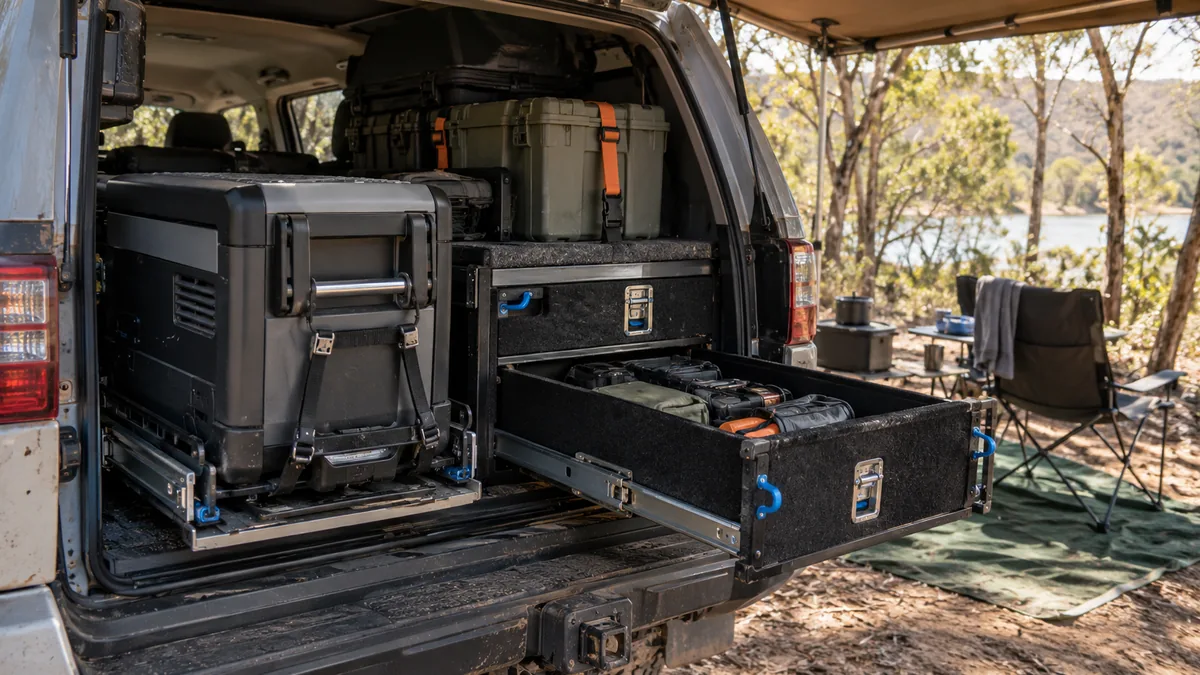
- Heavy items low and forward, and strap everything down. Loose items become dangerous in a sudden stop.
- Keep recovery gear easy to reach, not buried under camping gear.
Our 4WD packing guide has a full system.
6. Plan water, fuel and power
- Carry more water and fuel than you think you need. Low-range driving uses more fuel.
- Have a power plan for your fridge and lights. See 12V, dual battery and solar basics.
7. Drive smart
- Walk it first if you’re unsure about a creek crossing, rut or steep section.
- Slow and steady usually beats speed. Momentum helps in sand, but don’t overdo it.
- Never cross flooded roads or fast-flowing creeks.
- Stop before you’re tired, and arrive at camp before dark.
Your first-trip checklist
- Track open and conditions checked
- Someone knows your route and return time
- Tyre gauge, deflators and compressor
- Recovery boards, snatch strap, rated shackles, damper, shovel
- First aid kit and a way to call for help
- Extra water and fuel
- Load under GVM and strapped down
Top of the line vs best value
Well-known options sold in Australia, if you want a starting point. We haven’t independently tested every one, prices change often, and the right choice depends on your trip, so check current prices, specs and warranty before buying. Not ready to buy? Pop it in your Amazon cart so it’s there when you are.
Recovery boards
- Top of the line: MAXTRAX MKII recovery boards on Amazon · Add to Amazon cart: premium, well-known Australian recovery boards.
- Best value: BASHIK traction mats on Amazon · Add to Amazon cart: budget-friendly traction mats for lighter recovery jobs.
12V compressor
- Top of the line: NOCO AIR20 12V compressor on Amazon · Add to Amazon cart: premium high-output portable 12V compressor.
- Best value: NOCO AIR10 12V compressor on Amazon · Add to Amazon cart: budget-friendly portable compressor for occasional use.
Further reading
The bottom line
Start on an easy track, travel with another vehicle, learn your tyre pressures, carry basic recovery gear and know how to use it. Keep your load legal and secure, and you’ll come home with good stories instead of a tow bill.